How to Invoice Clients in 2026: 7 Steps to Get Paid Faster
How to Invoice Clients in 2026: 7 Steps to Get Paid Faster You finished the work, sent a polite email saying "here is what you owe," and then waited. And waited. For many small businesses, slow payment is not a client problem — it is an…
How to Invoice Clients in 2026: 7 Steps to Get Paid Faster
You finished the work, sent a polite email saying "here is what you owe," and then waited. And waited. For many small businesses, slow payment is not a client problem — it is an invoicing problem. A vague invoice, sent late, with no due date and no easy way to pay, practically invites delay. A clear invoice sent the same day, with a due date, a payment link, and every detail the client's accounts department needs, gets paid faster because there is nothing left to ask about.
The short answer: To invoice a client, put your business and client details, a unique invoice number, the invoice date and due date, an itemized list of what you delivered, the subtotal, taxes, and total, plus clear payment terms and a simple way to pay — then send it the day the work is done and follow up politely before it goes overdue. The seven steps below walk through each part, with a copy-ready template you can reuse for every job.
Note: This is general business information, not legal, tax, or accounting advice. Late-fee and sales-tax rules vary by state, so check your state's rules — or ask your accountant — before you add a fee or collect tax.
The Numbers Up Top
| Fact | Number |
|---|---|
| When to send the invoice | The same day the work is finished (or the same day goods ship) |
| Most common payment term in the US | Net 30 — payment due within 30 days of the invoice date |
| Deposit many service businesses ask for up front | 25–50% before work starts, balance on completion |
| First friendly reminder | 3–7 days before the due date |
| First overdue follow-up | The day after the due date, then weekly |
| IRS recordkeeping pointer | Keep invoices as supporting documents for your tax return, organized by year and type |
Key Takeaways
- Send it the day the work ends. Every day between finishing and invoicing is a day added to your wait, because most clients count payment terms from the invoice date.
- An invoice is not a receipt. An invoice asks for payment; a receipt confirms payment already made. Sending a clear invoice first avoids the back-and-forth of "can you send me the invoice?"
- Make payment effortless. A payment link or card option beats "mail a check" for speed — clients pay the invoice that is easiest to pay.
- Terms agreed before work starts are the ones that hold. Put payment terms, deposits, and late-fee policy in your quote or contract, not just on the invoice.
- Track every invoice until it is paid. An invoice tracker — even a simple spreadsheet — is what turns "I think they paid" into "invoice 1047 is 12 days overdue, follow up today."
What an Invoice Actually Is (and Is Not)
An invoice is a formal request for payment for goods delivered or services performed. It records what was sold, how much is owed, and when payment is due — and it becomes part of your business records. The IRS lists invoices among the supporting documents that back up your tax return, so keep them organized by year rather than scattered across email threads (see the IRS page on what kind of records to keep).
Three documents get confused constantly, so keep them straight:
| Document | When It Is Used | What It Means |
|---|---|---|
| Quote or estimate | Before the work | "Here is what the job will cost." No payment is due yet. |
| Invoice | After the work (or a milestone) | "Here is what you owe, and when." Payment is now due. |
| Receipt | After payment | "Thank you, we received your payment." Proof, not a request. |
Step 1: Agree the Terms Before You Start
The easiest invoice to collect is the one the client already expected. Before work begins, agree in writing — even a short email — on the price, what is included, the payment schedule, and what happens if payment is late. If you need a deposit, say so now: many service businesses ask for 25–50% up front, with the balance on completion. Put the same terms on the quote and on the invoice, so nothing changes between the two.
Step 2: Include Everything a Client Needs to Pay You
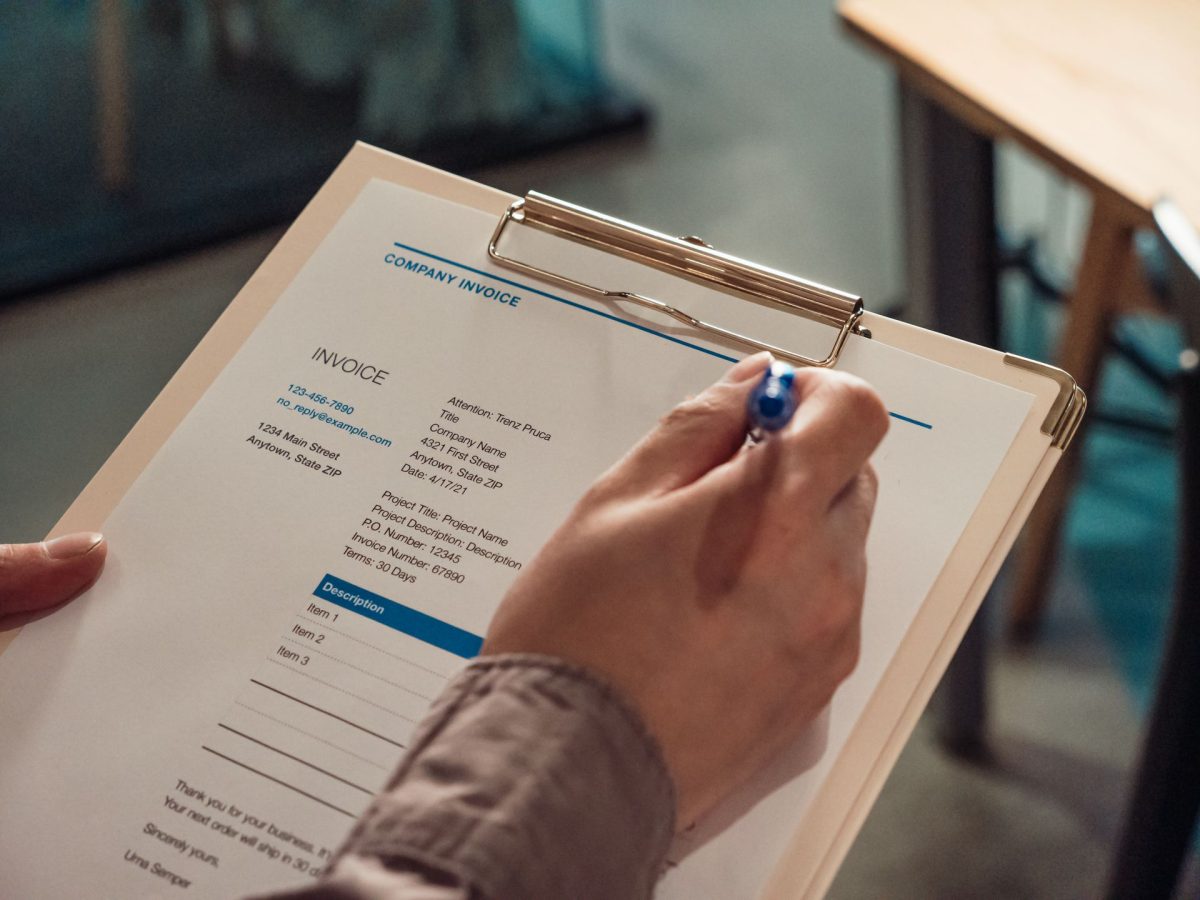
A client's accounts department cannot pay an invoice that is missing a detail — it goes into a "query" pile instead. Every invoice you send should include:
- Your business name, address, phone, and email. Use the same details everywhere so the client can match you to their vendor records.
- The client's name and address. Bill the right person or department, not just the company in general.
- A unique invoice number. Sequential numbers (001, 002, 003) or date-based numbers (2026-047) both work — the point is that every invoice is findable later.
- The invoice date and the due date. Never leave the due date off. "Due on receipt" and "Net 30" mean different things, so write the actual calendar date as well as the term.
- An itemized list. Describe each product or service, the quantity, the unit price, and the line total. "Consulting services — $500" invites questions; "Website homepage copy, 4 pages at $125 per page — $500" does not.
- Subtotal, taxes, discounts, and the total amount due. Show the math line by line. If you collect sales tax, show it as its own line with the rate, since sales-tax rules vary by state and by what you sell.
- Payment terms and payment methods. State the due date, any early-payment discount or late fee, and exactly how to pay — a payment link, bank-transfer details, or where to send a check.
Step 3: Choose Payment Terms That Fit the Job
Payment terms are simply the deal about when you get paid. Pick them deliberately instead of copying whatever your invoicing software defaults to:
| Term | What It Means | Best For |
|---|---|---|
| Due on receipt | Pay as soon as the invoice arrives | Small, one-off jobs and retail-style sales |
| Net 15 | Pay within 15 days | Regular clients you trust, and freelancers who need steady cash flow |
| Net 30 | Pay within 30 days | The US business standard; larger clients with monthly payment runs |
| 2/10 Net 30 | 2% discount if paid within 10 days, otherwise full amount in 30 days | Encouraging early payment without chasing |
| 50% deposit, balance on completion | Half up front, half when the work is done | Project work, custom orders, and new clients |
| Monthly retainer | Fixed amount billed each month | Ongoing services like maintenance, cleaning, or marketing |
On late fees: state the rate, how it is calculated, and when it starts, and make sure it complies with your state's rules first. A policy agreed in advance is far easier to enforce than a fee invented after payment is already late.
Step 4: Make Payment as Easy as Possible
Every extra step between your invoice and your money costs you days. Offer at least one instant option: an online payment link, card payment, or bank transfer (ACH) alongside checks. If you take card payments without a storefront, our guide to how to accept credit card payments without a storefront covers the options. Send the invoice as a PDF with a clear subject line — "Invoice 2026-047 from [Your Business Name] — due November 28" — and put the total and due date in the email body too.
Payments should land in a business account, not a personal one, so records stay clean at tax time. If you have not set one up yet, see how to open a business bank account in 2026.

Step 5: Follow Up on a Schedule, Not on a Feeling
Most unpaid invoices are not refusals — they are forgotten, misrouted, or stuck in someone's approval queue. A simple schedule fixes that:
- 3–7 days before the due date: a friendly heads-up — "Just a quick note that invoice 2026-047 for $500 is due on November 28. Here is the payment link again."
- The day after the due date: a polite check-in — "I wanted to check whether invoice 2026-047 has been processed, in case it went to the wrong inbox."
- Weekly after that: short, factual reminders with the invoice attached again, and a phone call if email goes unanswered for two weeks.
Keep every reminder polite and factual — you may need this client again, and a calm paper trail helps if a dispute ever reaches collection. A client who is always 60 days late is telling you to change their terms next time: shorter terms, a deposit, or payment before delivery.
Step 6: Track Every Invoice Until It Is Paid
Use one tracker for all invoices: number, client, date sent, due date, amount, status (sent, paid, overdue), and date paid. Invoicing software does this automatically; if you are choosing one, our roundup of the best accounting software for a small business with no employees compares options that include invoicing. Even a spreadsheet works if you update it the day money arrives. Reconcile monthly against your bank account so a "paid" invoice that never landed does not sit unnoticed.
Step 7: Learn From Each Invoice Cycle
Once a month, ask three questions: which clients pay on time, which terms get paid fastest, and where did invoices stall? If Net 30 clients consistently pay at day 45, switch new clients to Net 15 or a deposit model. If one line item always draws questions, rewrite its description. If a service bills the same amount monthly — say, a regular cleaning route like those in our guide to starting a house cleaning business — move it to a retainer invoice sent on the first of the month, and much of the chasing disappears.
Copy-Ready Invoice Template
Copy this block into your invoicing tool or document, fill in the brackets, and reuse it for every job:
- From: [Your Business Name], [Address], [Phone], [Email]
- Bill to: [Client Name], [Client Address], [Client Email]
- Invoice number: [2026-001] Invoice date: [October 29, 2026] Due date: [November 28, 2026 — Net 30]
- Item 1: [Description of service or product] — [Quantity] x $[Unit price] = $[Line total]
- Item 2: [Description] — [Quantity] x $[Unit price] = $[Line total]
- Subtotal: $[Amount] Sales tax ([Rate]%): $[Amount] Total due: $[Amount]
- Payment terms: Payment due by [Due date]. Late payments are subject to [your stated late-fee policy, if any, as agreed before work began].
- How to pay: [Payment link / bank transfer details / check payable to Your Business Name]
- Thank you for your business — please contact [Name, Email] with any questions about this invoice.
Frequently Asked Questions
How soon should I send an invoice after finishing work?
The same day, whenever possible. Clients usually count payment terms from the invoice date, so a week of delay at your end becomes a week of delay at theirs. If you bill monthly, pick a fixed send date — the first or last day of the month — and never let it slip.
What is the difference between Net 30 and due on receipt?
Net 30 gives the client 30 days from the invoice date to pay; due on receipt asks for payment as soon as the invoice arrives. Net 30 suits larger business clients with monthly payment runs, while due on receipt suits small, one-off jobs where waiting a month would hurt your cash flow.
Can I charge a late fee on an overdue invoice?
You can, if the fee was stated clearly in your terms before the work began and it complies with your state's rules — which vary, so check them first. A fee agreed in advance is reasonable; a surprise fee added after the fact usually creates a dispute instead of a payment.
Do I need invoicing software, or is a spreadsheet enough?
A spreadsheet is enough when you have a handful of invoices a month and you update it reliably. Once invoices, reminders, and payment links take more than an hour a week, invoicing software pays for itself by sending reminders automatically and marking invoices paid the moment money arrives.
Conclusion
Getting paid faster is rarely about pushing clients harder — it is about removing every reason to delay. Agree terms before you start, send a complete invoice the day the work ends, state a real due date, offer an easy way to pay, and follow up on a schedule. Do that consistently, and your invoice becomes the one that is easiest to approve, easiest to pay, and impossible to misunderstand.



0 Comments
No comments yet. Be the first to share your thoughts!