12 Holiday Marketing Ideas for Small Businesses (2026)
12 Holiday Marketing Ideas for Small Businesses That Bring In Real Sales (2026) The holidays are the biggest spending season of the year for American small businesses, and most of that money is decided in the next five weeks. Shoppers are…
12 Holiday Marketing Ideas for Small Businesses That Bring In Real Sales (2026)
The holidays are the biggest spending season of the year for American small businesses, and most of that money is decided in the next five weeks. Shoppers are already making lists and picking which local shops get their money. A small business that plans a few simple moves now can take a real share of that spending without a big ad budget. You need a clear offer, a decorated storefront — online and off — and a reason for customers to choose you over the big-box store down the road.
The Short Answer
The best holiday marketing ideas for small businesses are: go all-in on Small Business Saturday (November 28, 2026), sell gift bundles and gift cards, run one clear limited-time offer, decorate your window and Google Business Profile, send three short holiday emails, and team up with neighboring shops. Start the week of November 23 and keep every offer simple enough to explain in one sentence.
Key Takeaways
- Holiday retail sales are forecast at $1.013 trillion for November–December 2026 (NRF), up 4.2% on 2025 — the first season above $1 trillion.
- Small Business Saturday falls on November 28, 2026 — five days from now. It is the single highest-leverage day for a local shop all year.
- 43% of holiday shoppers start buying before November, so the best time to launch your holiday offers was last week. The second-best time is today.
- Gift cards are the most-wanted gift (47% of shoppers) and the easiest high-margin product a small business can sell.
- Pick three or four ideas and do them well. Twelve half-finished promotions earn less than three done properly.
The Numbers: Why the Holidays Pay for Small Businesses
The National Retail Federation forecasts US holiday retail sales of $1.013 trillion for November and December 2026, up 4.2% from $972 billion in 2025. Deloitte's 2026 survey puts the average household's planned holiday spend at $1,654, and PwC found shoppers plan to spend about $708 on gifts alone. An estimated 182.7 million Americans plan to shop over the Thanksgiving weekend. The catch is timing: early shoppers have the biggest budgets, so a shop that waits until mid-December competes for leftovers.
| Holiday number | Figure | Source |
|---|---|---|
| US holiday retail sales, Nov–Dec 2026 (forecast) | $1.013 trillion, up 4.2% | National Retail Federation, Oct 2026 |
| US holiday retail sales, Nov–Dec 2025 | $972 billion | National Retail Federation |
| Average household holiday spend, 2026 | $1,654 | Deloitte holiday survey 2026 |
| Average planned gift spend per shopper | $708 | PwC Holiday Outlook 2026 |
| Shoppers planning to shop Thanksgiving weekend | 182.7 million | National Retail Federation |
| Shoppers who start holiday buying before November | 43% | National Retail Federation |
| Most-wanted gift: gift cards | 47% of shoppers | National Retail Federation |
| Small Business Saturday spending since 2012 | $241 billion | US Small Business Administration |
The 12 Ideas at a Glance
| # | Idea | Typical cost | Effort | Best for |
|---|---|---|---|---|
| 1 | Go all-in on Small Business Saturday | $0–$50 | Half a day | Every local shop |
| 2 | Build holiday gift bundles | $0 (uses stock) | 2–3 hours | Retail, makers, food shops |
| 3 | Sell gift cards and e-gift cards | $0–$40 | 1 hour | Every business |
| 4 | Run one clear limited-time offer | $0 | 1 hour | Retail and services |
| 5 | Turn your window and Google profile festive | $20–$60 | Half a day | Shops with a storefront |
| 6 | Send a 3-email holiday sequence | $0 | 2–3 hours | Businesses with an email list |
| 7 | Post a holiday countdown on social media | $0 | 15 min a day | Every business |
| 8 | Team up with the business next door | $0–$25 | Half a day | Main-street shops |
| 9 | Give December customers a January reason to return | $0 | 1 hour | Every business |
| 10 | Offer free gift wrapping | $15–$40 | Ongoing | Retail and makers |
| 11 | Set holiday hours early, add curbside pickup | $0 | 1 hour | Shops and services |
| 12 | Publish one holiday gift guide on your website | $0 | 2–3 hours | Businesses with a website |
1. Go All-In on Small Business Saturday (November 28, 2026)
Small Business Saturday is the Saturday after Thanksgiving — this year, November 28 — and it is the one shopping day built entirely around businesses like yours. Founded by American Express in 2010 and co-sponsored by the US Small Business Administration, it gets national press every year without you spending a dollar. Shoppers arrive already in a shop-small mood. Keep it simple: one special offer for the day (15% off everything, or a free gift with a $50 purchase), extended hours, and something worth photographing — a decorated entrance, free hot cocoa, a local musician. Put the date on your door and your Google Business Profile.
2. Build Holiday Gift Bundles
A gift bundle turns three slow-moving products into one easy purchase. A candle shop can bundle a candle, a box of matches, and a small ornament for $35. A bakery can bundle a loaf, a jar of jam, and a bag of cookies as a "hostess gift." Price the bundle 10% to 15% below the sum of its parts and give it a name people can ask for, like "The Cozy Night Bundle." Display bundles near the register. Two or three are plenty. This is also the fastest way to clear stock that has been sitting since summer.
3. Sell Gift Cards — and Push E-Gift Cards
Gift cards are the most-wanted holiday gift in America: 47% of shoppers say they would like to receive one, ahead of clothing at 44%. For a small business, they are close to perfect: you get the cash now, the customer spends it later, and a meaningful share are never fully redeemed. Most point-of-sale systems let you turn them on in minutes. Sell e-gift cards too, and put the link everywhere: your website, your Google Business Profile, your email signature, and every social media bio. Last-minute shoppers buy e-gift cards on December 23 and 24. Service businesses can sell them too — a $50 gift card for a haircut brings a brand-new customer in January.
4. Run One Clear Limited-Time Offer
One offer, one deadline, one sentence. "20% off all ornaments through Sunday." "Buy two, get the third free, this weekend only." "Free delivery on orders over $40 until December 20." The offer works because the deadline forces a decision. A discount with no end date is just a price cut, and five different offers on one page is a page nobody reads. Protect your margin: if your products cost you 50% of the sale price, a 20% discount still leaves 30% gross margin; a 40% discount leaves almost nothing. Service businesses do better with value-adds — a free add-on costs minutes, not margin. Use the same words on your door, your Google profile, and one email.
5. Turn Your Window and Google Profile Festive
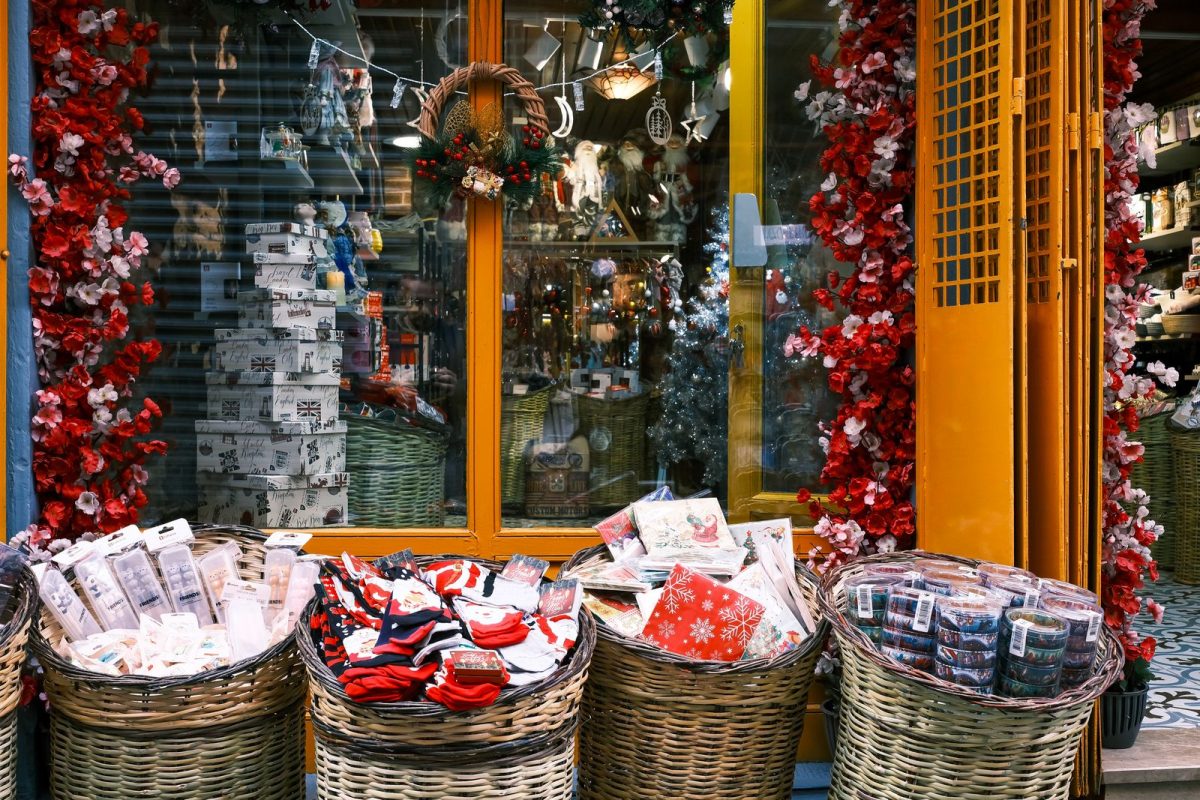
Your window is a free billboard, and in December it is the one that matters most. A clean, lit, decorated window tells a passerby two things: you are open, and you have gifts. You do not need a professional display — a wreath, warm string lights, your best-selling products at eye level, and a hand-written sign with your holiday offer will beat a dark, cluttered window every time. Do the same thing online, because most customers check you on Google before they visit. Add fresh holiday photos to your Google Business Profile — your decorated window, your gift bundles, your staff in holiday aprons — and post a holiday update with your offer and hours. See how many photos your Google Business Profile needs, and pair this with our local marketing ideas for small towns.
6. Send a Short 3-Email Holiday Sequence
Email is still the highest-return marketing channel for small businesses, and the holidays are when your list is most valuable. Three short emails are enough: email one this week announcing your holiday offer and Small Business Saturday plans; email two in mid-December with gift ideas and last order-by dates; email three on December 21 or 22 for last-minute shoppers, pushing e-gift cards and in-store pickup. Keep each email to one idea, one picture, and one button, with plain subject lines: "Our Small Business Saturday deal (Nov 28)", "Last day to order for Christmas delivery", "Still need a gift? E-gift cards in 2 minutes." A list of 200 local customers who open your emails beats a list of 5,000 strangers. New to email? See how to get your first 100 newsletter subscribers.
7. Post a Holiday Countdown on Social Media
A countdown gives you something to post every day without thinking. "12 days of gifts" — one gift idea a day, with a photo and a price. "5 days to Small Business Saturday" — a behind-the-scenes photo each morning. "Last 3 days for Christmas delivery" — urgency that is honest because it is real. Film or photograph the real thing: your hands wrapping a gift, the shelf you just restocked, the regular customer who has shopped with you for ten years. Short phone videos outperform polished graphics for local businesses, because people follow local businesses to feel local. Reply to every comment the same day, and pin your holiday offer to the top of your profile. If you run a Facebook group for your customers, use it — see our guide to using Facebook Groups to get local customers.
8. Team Up With the Business Next Door
Two shops are more interesting than one. A coffee shop and a bookstore can run a joint "coffee and a book" bundle. A florist and a bakery can cross-promote: every bouquet comes with a coupon for the bakery next door, and every cake box carries a coupon for the florist. The simplest version costs nothing: display each other's flyers and mention each other on social media for two weeks. The stronger version is a shared event — a "Main Street Holiday Stroll" on one evening, with each shop offering a small tasting or discount and a shared map customers can follow. Events like this are exactly how small towns beat big-box stores. Split the work so no one shop carries the whole evening — see our guide to increasing foot traffic.
9. Give December Customers a January Reason to Return
December brings you customers you may never see again — unless you give them a reason to come back. The cheapest way is a January coupon handed to every December buyer: "$10 off in January" printed on the receipt, or a card tucked into the shopping bag. January is the slowest month for most small businesses, so a coupon that brings even one in five December shoppers back is worth real money. Make it expire at the end of January — 20% off, or $10 off a $40 purchase. Also ask every December customer for a Google review while they are happy; our guide to getting more Google reviews has scripts you can copy.
10. Offer Free Gift Wrapping
Free gift wrapping is a small cost that removes a real objection. Many shoppers will buy a gift from you instead of ordering online if they can walk out with it wrapped and ready to give. A roll of kraft paper, ribbon, and a few sprigs of greenery costs $15 to $40 for the season, and the wrapping station doubles as a display that makes your shop feel festive. Photograph your wrapped gifts and use the photos everywhere — your window, your social media, your Google Business Profile. Service businesses: present gift certificates in a nice envelope with a ribbon.

11. Set Holiday Hours Early — and Add Curbside Pickup
Nothing loses a sale faster than a customer driving to your shop and finding it closed, or searching for your hours online and finding last year's. Set your holiday hours now, extend them for the two weeks before Christmas if you can, and update them everywhere at the same time: your door, your website, and your Google Business Profile. See our guide to setting holiday hours on Google Business Profile. Add curbside pickup if you do not already offer it — December shoppers are busy, and the option to order by phone and pick up at the curb wins sales from people who would otherwise order online. Service businesses: extend booking hours — December customers book at 10 p.m., not 10 a.m.
12. Publish One Holiday Gift Guide on Your Website
A gift guide is the one holiday idea that keeps working after Christmas. A page titled "10 Gifts Under $25 From Our Shop" or "The Best Gifts for New Homeowners in [Your Town]" can rank on Google for weeks, bring in shoppers who have never heard of you, and be reused — with new products — next year. Write it for real people: one photo per gift, a one-line reason it is a good gift, and the price. Share it by email, social media, and your Google Business Profile. If you want it to rank beyond your town, a few quality backlinks help — a guest posting service can place your guide on real blogs in your niche. Before you publish, check it with free SEO tools and build it on our local SEO guide for small businesses.
A $200 Holiday Marketing Budget That Actually Works
Here is a worked example for a small shop with $200 to spend across the whole season — every dollar accounted for, and every item chosen because it brings a customer back or brings a new one in.
| What you buy | Cost | What it does |
|---|---|---|
| Window lights, wreath, and a hand-painted sign | $50 | Turns passersby into visitors for five weeks |
| Gift wrap paper, ribbon, and gift bags | $30 | Free gift wrapping for roughly 100 gifts |
| January-return coupons (printed cards) | $20 | Brings December buyers back in the slow month |
| One local Facebook/Instagram ad, 10-mile radius | $60 | Reaches nearby shoppers for Small Business Saturday |
| Cocoa, cups, and cookies for the Saturday event | $40 | Keeps visitors in the shop longer — and spending |
| Total | $200 | Five weeks of promotion, one big day |
Do the math: if the $60 ad brings 30 extra visitors and one in three spends $35, that is $350 in sales from a $60 spend — and several will return in January with a coupon. The point is not to spend $200; it is to spend it on things that touch a customer, not on things nobody sees.
Your 4-Week Holiday Marketing Calendar
Copy this plan and tick it off as you go. It starts today, Monday, November 23, and runs to Christmas Eve.
| Week | Dates | Do this |
|---|---|---|
| Week 1 | Nov 23–29 | Pick your one offer. Decorate the window. Announce Small Business Saturday (Nov 28) by email and on Google. Build two gift bundles. Turn on gift cards. |
| Week 2 | Nov 30–Dec 6 | Send holiday email two (gift ideas + order-by dates). Start the social media countdown. Refresh Google Business Profile photos. Launch the January-return coupon. |
| Week 3 | Dec 7–13 | Publish your gift guide. Run the joint event with a neighboring shop. Start free gift wrapping. Ask happy customers for Google reviews. |
| Week 4 | Dec 14–24 | Send the last-minute email (e-gift cards + curbside pickup). Extend hours. Promote "last day to order" deadlines. Thank every customer by name where you can. |
Starting late? Skip the decoration and go straight to the offer, the email, and the gift cards. Add a referral bonus too — see our guide to starting a referral program. For service businesses without a storefront, swap the window display for a holiday offer on your booking page and a Nextdoor post aimed at your own neighborhood.
Frequently Asked Questions
When should a small business start holiday marketing?
By early November at the latest. 43% of holiday shoppers start buying before November, and Small Business Saturday falls on November 28, 2026. Starting late? Launch your offer, gift cards, and one email this week — those three moves cover most of the opportunity.
How much should a small business spend on holiday marketing?
Most small shops can run a strong holiday campaign for $100 to $300: decorations, gift wrap, printed coupons, and one small local social media ad. The biggest returns come from free moves: bundles from existing stock, one clear offer, and fresh profile photos.
What is the best holiday promotion for a small business?
Small Business Saturday (November 28, 2026) is the highest-leverage day, because shoppers arrive already wanting to support local shops. After that, gift cards and bundles: the most-wanted gift, and a higher average sale.
Do holiday gift guides actually bring in sales?
Yes, when they are specific and local. A guide like "10 Gifts Under $25 for New Homeowners in Springfield" ranks for gift searches, gets shared in local groups, and keeps working for weeks. Generic guides compete with giant retailers and rarely rank.
Conclusion
The holidays reward small businesses that act early and keep things simple. Pick three or four ideas from this list — Small Business Saturday, gift bundles, gift cards, one clear offer — and do them properly this week. Update your hours, decorate the window, and send the first email. The $1.013 trillion holiday season is already underway. Your share of it is decided by what you do in the next five days, not by what you plan to do next month.
Useful resources: if you publish a holiday gift guide, a guest posting service can help it earn backlinks from real blogs, and free SEO tools can check the page's title, meta description, and headings before you share it.



0 Comments
No comments yet. Be the first to share your thoughts!